
Project Overview
A locker management software company needed an integration between Clover POS terminals and their distributed locker system. Each restaurant location runs its own locker management server, and staff were manually copying every order from the Clover terminal into the locker interface. It was a time-consuming process prone to errors. Third-party delivery orders (Skip The Dishes, Uber Eats, etc) complicated things further by requiring custom PIN generation based on what each driver's app could display.
- Timeline: February - August 2024 (part-time), with rollout in November 2024
- Role: Solo developer
- Skills: requirements gathering, architecture, development, Docker deployment, and API integration
The Challenge
Adapting to API Changes Mid-Project
Midway through development, we changed authentication from simple bearer tokens to full OAuth token exchanges. This required redesigning the authentication architecture to handle 30-minute token expiration across distributed locker systems.
Distributed Token Management
Each restaurant location runs its own locker server and pulls data from Clover directly, not through a central datacenter. The solution needed a secure token refresh service that any authorized locker could access when tokens expired or were rejected.
External Dependency Outage Mitigation
I designed a system for handling outages with third-party services. The system handles failures gracefully. There is monitoring on the token exchanges.
Complex Data Transformation
Mapping order data between Clover's schema and the locker system's format involved reconciling different entity relationships, inconsistent data types (strings vs numbers), and parsing human-readable strings from third-party delivery integrations.
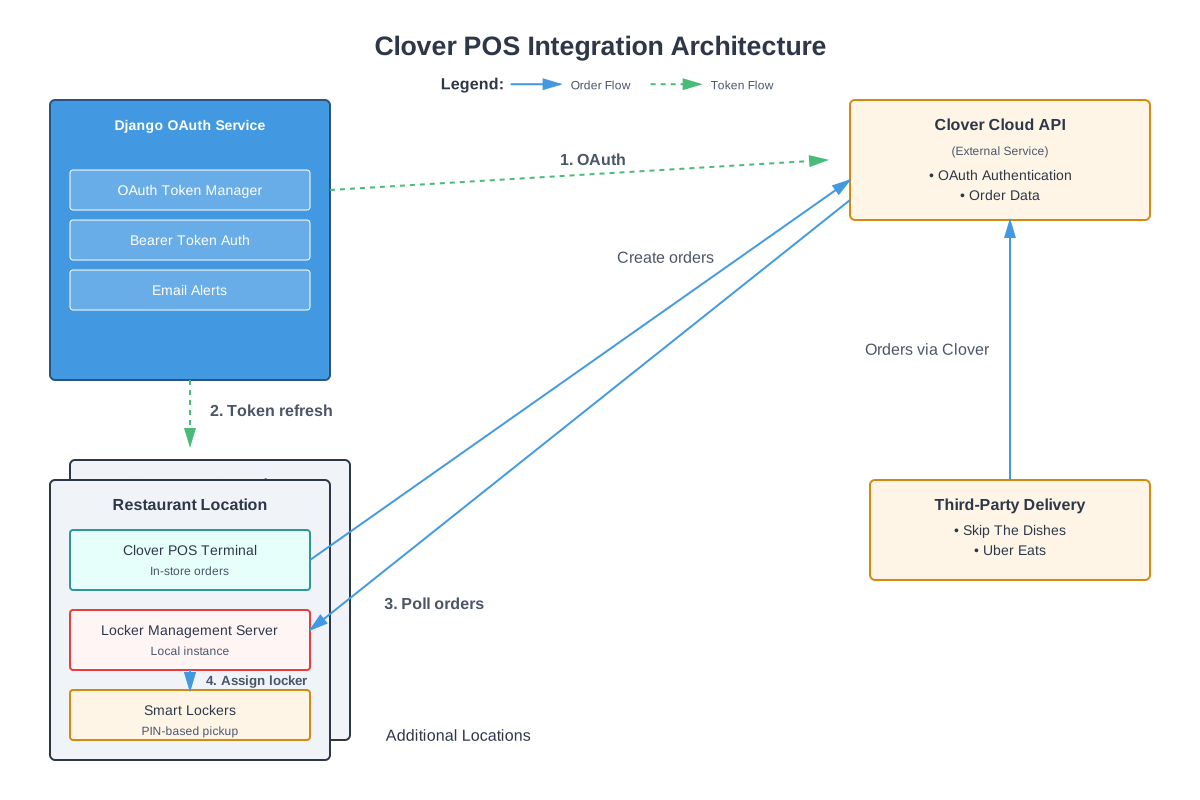
System Architecture
The Solution
I built a standalone Django application serving as a secure OAuth token exchange service, with the following architecture:
OAuth Token Exchange Service
Built a centralized Django application that handles Clover's OAuth flow and manages token lifecycle. When Clover migrated from simple bearer tokens to OAuth mid-project, I redesigned the authentication layer to handle 30-minute token expiration across all distributed locker locations.
Distributed Token Refresh
Rather than centralizing all API calls, each locker location authenticates to the Django app using long-lived bearer tokens. When a locker's Clover token expires (every ~30 minutes) or is rejected, it requests a fresh token from the central service. This allows the distributed locker servers to maintain their own direct connections to Clover's API while ensuring secure token management.
Security Layer
- TLS encryption for all token exchanges
- Bearer token authentication to prevent unauthorized token requests
- Rate limiting to protect against abuse
Near Real-time Order Synchronization
Implemented Celery background workers to poll Clover's API at regular intervals, transforming and importing orders into each locker system. Email alerts notify operators of failures, with automatic retry logic that continues polling until Clover's API recovers from outages.
Data Transformation Pipeline
Built adapters to map between Clover's order schema and the locker system's expected format, handling inconsistent data types and parsing third-party delivery order strings into structured data.
Production-Ready Deployment
Containerized the entire application with Docker for rapid redeployment and health monitoring, ensuring the token service remains available to distributed locker locations.

Screen capture
Results
The application successfully passed internal QA and received positive feedback from the client's technical team. The system handled the core integration challenges:
- Automated order flow from Clover POS to lockers, eliminating manual double-entry
- Secure, distributed token management across multiple locker locations
- Resilient handling of Clover's periodic API outages
- Support for both direct in-store entry and third-party delivery orders
Key Takeaway
This project demonstrates adaptability in the face of changing requirements, from mid-project API authentication changes to evolving business needs, while maintaining focus on delivering working software that solves real operational problems.
References
Let's Work Together
I am based in Victoria, British Columbia, and I work with businesses across Vancouver Island and the Pacific Northwest. If the developer that built your Django application has moved on and no one is maintaining your codebase, or if you run an MSP and a client is asking for custom software work your team does not handle, I'd love to hear from you.
Schedule a free 30-minute consultation to talk about your needs. No commitment required.